


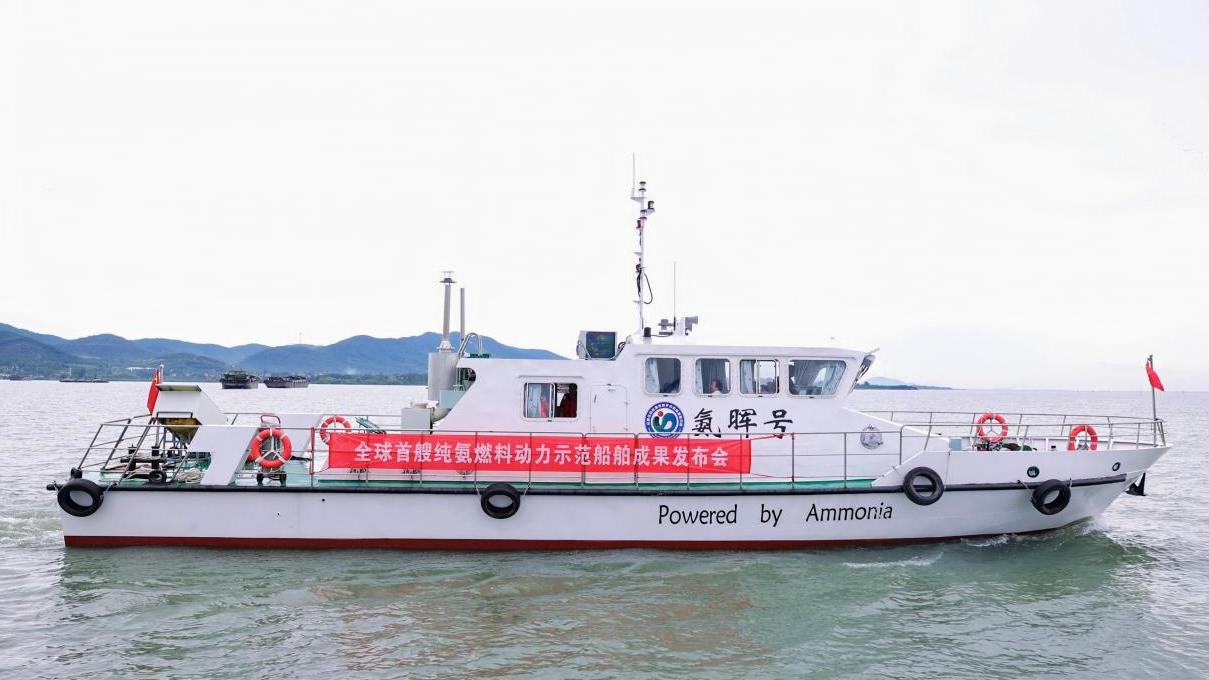
The world’s first pure ammonia-powered demonstration vessel, the *Anhui*, has successfully completed its maiden voyage in Hefei, eastern China’s Anhui Province, a landmark achievement for the future of green shipping.
Ammonia, long used as a key feedstock in the chemical industry, is gaining global attention as a next-generation marine fuel. With its high energy density and carbon-free composition, ammonia produces only water and nitrogen when fully combusted, positioning it as a promising solution for decarbonizing the shipping industry. However, challenges such as ignition difficulties and unstable combustion remain barriers to widespread adoption.
The *Anhui* represents a breakthrough. Jointly developed by the Institute of Energy at the Hefei Comprehensive National Science Center and its subsidiary, Shenzhen Haixu New Energy Co., Ltd., the vessel is powered by a 200-kilowatt high-speed gas internal combustion generator, two 100-kilowatt propulsion motors, and a twin-screw propulsion system. It can carry up to 50 tonnes at a rated speed of 10 knots.
According to Wu Dianwu of the Institute of Energy, the research team overcame several critical technical hurdles. These included achieving pure ammonia plasma ignition, ensuring sustained and stable combustion, developing efficient catalytic cracking systems to produce hydrogen from ammonia, and perfecting hydrogen-ammonia mixed gas control within internal combustion engines. The team also created a pure ammonia fuel burner and a suite of catalytic cracking devices tailored for ammonia gas.
The maiden voyage demonstrated stable combustion of pure ammonia fuel, near-zero carbon dioxide emissions, and controlled nitrogen oxide output. Wu emphasized that the success validates ammonia-hydrogen fuels as viable not only for shipping but also for broader applications in land transport, industrial boilers, and fuel cells.
Industry experts view the accomplishment as a milestone. Wang Junli, secretary-general of the Chinese Society of Naval Architects and Marine Engineers, highlighted that if pure ammonia engines can be scaled to the megawatt level, their applications will grow dramatically. Such advances, he noted, could play a pivotal role in achieving China’s dual carbon goals and accelerating the transition to a clean, low-carbon energy system for waterborne transport.
Globally, interest in ammonia as a marine fuel is rising. Japan, Norway, and other shipping nations are already investing heavily in ammonia-powered vessel development. The International Energy Agency projected in 2021 that ammonia could account for up to 45% of global shipping energy demand by 2050 under a net-zero emissions pathway. The *Anhui*’s successful maiden voyage now adds momentum to this vision, signaling a new chapter in maritime innovation.
Source: Xinhua News Agency
Ammonia, long used as a key feedstock in the chemical industry, is gaining global attention as a next-generation marine fuel. With its high energy density and carbon-free composition, ammonia produces only water and nitrogen when fully combusted, positioning it as a promising solution for decarbonizing the shipping industry. However, challenges such as ignition difficulties and unstable combustion remain barriers to widespread adoption.
The *Anhui* represents a breakthrough. Jointly developed by the Institute of Energy at the Hefei Comprehensive National Science Center and its subsidiary, Shenzhen Haixu New Energy Co., Ltd., the vessel is powered by a 200-kilowatt high-speed gas internal combustion generator, two 100-kilowatt propulsion motors, and a twin-screw propulsion system. It can carry up to 50 tonnes at a rated speed of 10 knots.
According to Wu Dianwu of the Institute of Energy, the research team overcame several critical technical hurdles. These included achieving pure ammonia plasma ignition, ensuring sustained and stable combustion, developing efficient catalytic cracking systems to produce hydrogen from ammonia, and perfecting hydrogen-ammonia mixed gas control within internal combustion engines. The team also created a pure ammonia fuel burner and a suite of catalytic cracking devices tailored for ammonia gas.
The maiden voyage demonstrated stable combustion of pure ammonia fuel, near-zero carbon dioxide emissions, and controlled nitrogen oxide output. Wu emphasized that the success validates ammonia-hydrogen fuels as viable not only for shipping but also for broader applications in land transport, industrial boilers, and fuel cells.
Industry experts view the accomplishment as a milestone. Wang Junli, secretary-general of the Chinese Society of Naval Architects and Marine Engineers, highlighted that if pure ammonia engines can be scaled to the megawatt level, their applications will grow dramatically. Such advances, he noted, could play a pivotal role in achieving China’s dual carbon goals and accelerating the transition to a clean, low-carbon energy system for waterborne transport.
Globally, interest in ammonia as a marine fuel is rising. Japan, Norway, and other shipping nations are already investing heavily in ammonia-powered vessel development. The International Energy Agency projected in 2021 that ammonia could account for up to 45% of global shipping energy demand by 2050 under a net-zero emissions pathway. The *Anhui*’s successful maiden voyage now adds momentum to this vision, signaling a new chapter in maritime innovation.
Source: Xinhua News Agency