

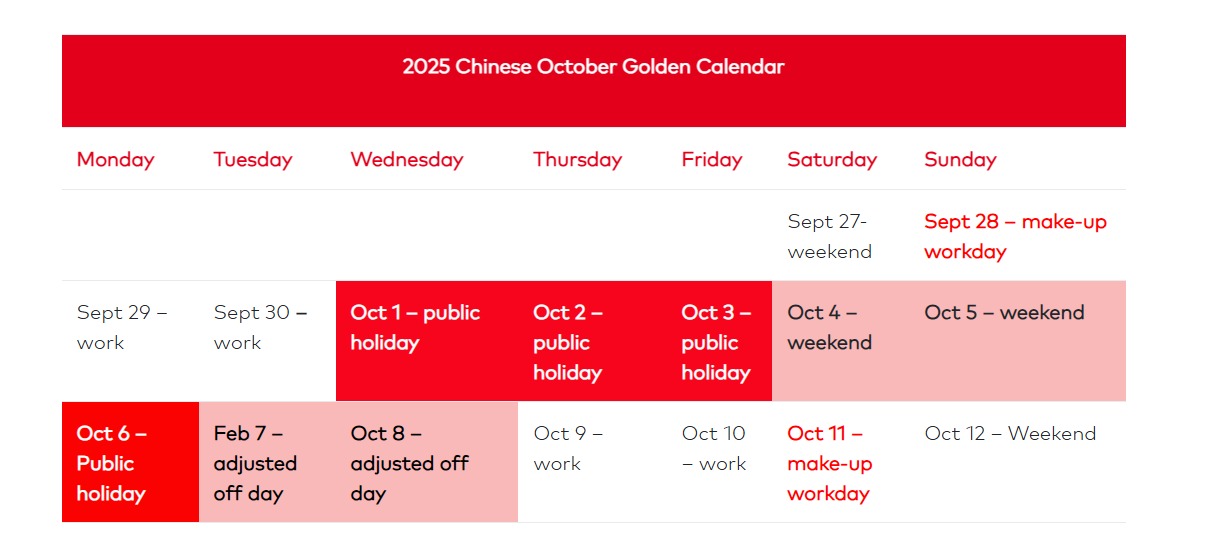
China’s annual October Golden Week will run from October 1 to October 8, 2025, combining National Day celebrations with the Mid-Autumn Festival. To balance the extended break, employees will work on September 28 (Sunday) and October 11 (Saturday) as official make-up days.
• Holiday Pay Rules
– Statutory holidays (Oct 1–3, Oct 6): employees working must be paid at 300% of daily wages.
– Adjusted rest days/weekend days (Oct 4–5, Oct 7–8): work requires 200% pay or compensatory time off.
– Under non-standard working-hour systems, rules vary by region. For example, Beijing exempts non-fixed hour employees from overtime pay on holidays, while Shanghai requires 300% holiday pay.
• Business and HR Impact
– Supply chain disruptions: factories, customs, and logistics providers may close or reduce operations. Employers are advised to stock critical materials and adjust delivery schedules in advance.
– Extended leave: staff often combine annual leave with the holiday, creating potential absences of up to two weeks. Early communication and contingency planning are key.
– Employee well-being: with the holiday overlapping the Mid-Autumn Festival (Oct 6), employers are encouraged to be flexible and culturally sensitive, offering gestures like mooncakes or team events to boost morale.
• Recommendations for Employers
– Ensure compliance with China’s labor laws on holiday pay and overtime.
– Update HR policies and contracts to reflect clear holiday and overtime rules.
– Coordinate with suppliers and partners to mitigate disruptions.
– Prepare contingency staffing plans, including cross-training and backups.
China’s Golden Week remains a vital cultural and economic period. For businesses, balancing compliance, operational continuity, and employee well-being will be essential to navigating the 2025 holiday smoothly.
Source: China Briefing
• Holiday Pay Rules
– Statutory holidays (Oct 1–3, Oct 6): employees working must be paid at 300% of daily wages.
– Adjusted rest days/weekend days (Oct 4–5, Oct 7–8): work requires 200% pay or compensatory time off.
– Under non-standard working-hour systems, rules vary by region. For example, Beijing exempts non-fixed hour employees from overtime pay on holidays, while Shanghai requires 300% holiday pay.
• Business and HR Impact
– Supply chain disruptions: factories, customs, and logistics providers may close or reduce operations. Employers are advised to stock critical materials and adjust delivery schedules in advance.
– Extended leave: staff often combine annual leave with the holiday, creating potential absences of up to two weeks. Early communication and contingency planning are key.
– Employee well-being: with the holiday overlapping the Mid-Autumn Festival (Oct 6), employers are encouraged to be flexible and culturally sensitive, offering gestures like mooncakes or team events to boost morale.
• Recommendations for Employers
– Ensure compliance with China’s labor laws on holiday pay and overtime.
– Update HR policies and contracts to reflect clear holiday and overtime rules.
– Coordinate with suppliers and partners to mitigate disruptions.
– Prepare contingency staffing plans, including cross-training and backups.
China’s Golden Week remains a vital cultural and economic period. For businesses, balancing compliance, operational continuity, and employee well-being will be essential to navigating the 2025 holiday smoothly.
Source: China Briefing