


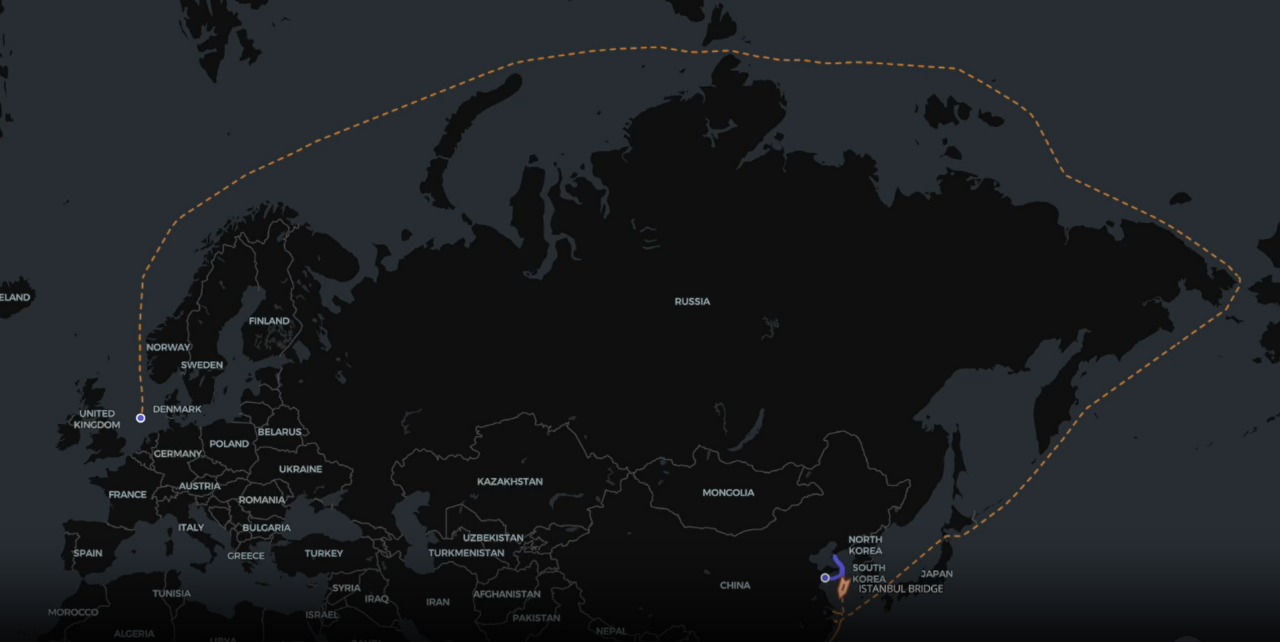
The Istanbul Bridge, a Chinese-operated containership, is set to arrive at Felixstowe, the UK’s largest container terminal on the afternoon of October 13, after completing a groundbreaking Arctic transit in just 20 days.
The Panamax-class vessel covered approximately 7,500 nautical miles from Ningbo-Zhoushan, China, via the Northern Sea Route (NSR) across the Arctic. By comparison, a traditional route through the Suez Canal spans around 11,000 nautical miles and typically takes 40–50 days.
This marks the first-ever liner-type containership service using the Arctic to connect Asia and Europe, and the first time a container vessel has traveled from China to the UK through the polar region. The route includes stops at multiple Chinese and European ports.
The service, branded “China-Europe Arctic Express” by operator Sealegend, builds on the company’s acquisition of an Ice-1-class containership in 2023, laying the groundwork for Arctic shipping operations.
*Environmental and Regulatory Concerns*
Li Xiaobin, Sealegend’s Chief Operating Officer, emphasized the emissions benefits from the shorter sailing distance. However, environmental groups warn that Arctic traffic could have harmful local impacts—particularly from black carbon emissions if heavy fuel oil is used. It remains unclear what fuel the Istanbul Bridge used and whether the voyage fully complied with the IMO’s Polar Code.
*Strategic Timing and Supply Chain Benefits*
The voyage is designed to get ahead of the year-end surge, when vessels from Asia arrive in Europe with goods for the holiday season.
According to Li, the Arctic shortcut “significantly improves supply chain efficiency, reduces business inventory requirements by 40 percent, and lowers capital costs.”
Capable of carrying up to 4,843 TEU, the vessel departed Ningbo-Zhoushan on September 22 and crossed the NSR in just five days at an average speed of 17 knots. With minimal sea ice remaining late in the summer season, the vessel completed the passage without an icebreaker escort.
Following its call at Felixstowe, the Istanbul Bridge will continue to Rotterdam, Hamburg, and Gdansk.
*Growing Arctic Shipping Activity*
Although the Istanbul Bridge has drawn the most attention, it is not alone. At least three other containerships were active on the NSR at the same time this season, making point-to-point voyages. The Northern Sea Route has already set a new record in 2024 with over 20 containership transits.
The first full transit by a containership occurred just seven years ago, in August 2018, when Maersk routed the Venta Maersk from Vladivostok to St. Petersburg with a stop in Bremerhaven. Since then, most Western lines have retreated from the route due to environmental and geopolitical concerns, leaving Chinese and Russian operators to expand their presence.
Although still niche around 100 vessel transits in 2024 compared to roughly 13,000 through the Suez Canal, Arctic operations are steadily growing.
Another Chinese operator, NewNew Shipping, has five vessels active in the region this summer and aims to exceed its 2023 record of 13 Arctic sailings.
Source: GCaptain
The Panamax-class vessel covered approximately 7,500 nautical miles from Ningbo-Zhoushan, China, via the Northern Sea Route (NSR) across the Arctic. By comparison, a traditional route through the Suez Canal spans around 11,000 nautical miles and typically takes 40–50 days.
This marks the first-ever liner-type containership service using the Arctic to connect Asia and Europe, and the first time a container vessel has traveled from China to the UK through the polar region. The route includes stops at multiple Chinese and European ports.
The service, branded “China-Europe Arctic Express” by operator Sealegend, builds on the company’s acquisition of an Ice-1-class containership in 2023, laying the groundwork for Arctic shipping operations.
*Environmental and Regulatory Concerns*
Li Xiaobin, Sealegend’s Chief Operating Officer, emphasized the emissions benefits from the shorter sailing distance. However, environmental groups warn that Arctic traffic could have harmful local impacts—particularly from black carbon emissions if heavy fuel oil is used. It remains unclear what fuel the Istanbul Bridge used and whether the voyage fully complied with the IMO’s Polar Code.
*Strategic Timing and Supply Chain Benefits*
The voyage is designed to get ahead of the year-end surge, when vessels from Asia arrive in Europe with goods for the holiday season.
According to Li, the Arctic shortcut “significantly improves supply chain efficiency, reduces business inventory requirements by 40 percent, and lowers capital costs.”
Capable of carrying up to 4,843 TEU, the vessel departed Ningbo-Zhoushan on September 22 and crossed the NSR in just five days at an average speed of 17 knots. With minimal sea ice remaining late in the summer season, the vessel completed the passage without an icebreaker escort.
Following its call at Felixstowe, the Istanbul Bridge will continue to Rotterdam, Hamburg, and Gdansk.
*Growing Arctic Shipping Activity*
Although the Istanbul Bridge has drawn the most attention, it is not alone. At least three other containerships were active on the NSR at the same time this season, making point-to-point voyages. The Northern Sea Route has already set a new record in 2024 with over 20 containership transits.
The first full transit by a containership occurred just seven years ago, in August 2018, when Maersk routed the Venta Maersk from Vladivostok to St. Petersburg with a stop in Bremerhaven. Since then, most Western lines have retreated from the route due to environmental and geopolitical concerns, leaving Chinese and Russian operators to expand their presence.
Although still niche around 100 vessel transits in 2024 compared to roughly 13,000 through the Suez Canal, Arctic operations are steadily growing.
Another Chinese operator, NewNew Shipping, has five vessels active in the region this summer and aims to exceed its 2023 record of 13 Arctic sailings.
Source: GCaptain