


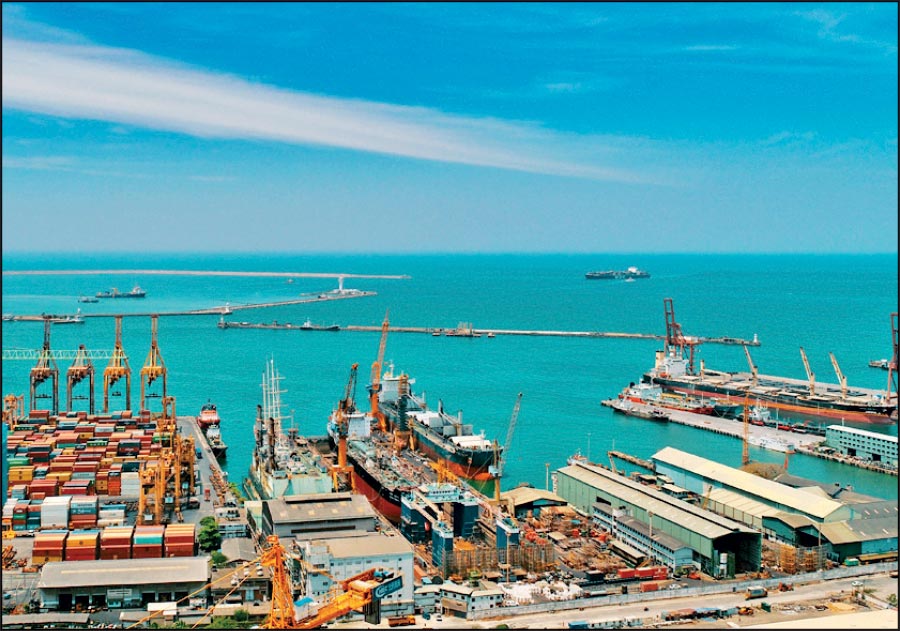
Sri Lankan exporters are once again grappling with uncertainty as operational delays at the Port of Colombo have led to vessels bypassing the port and instead discharging cargo at Indian terminals with minimal delay.
These last-minute omissions by shipping lines leave exporters with no viable alternatives, often delaying Colombo-bound cargo by as much as two weeks.
Just last week, ZIM Integrated Shipping Services Ltd. announced that its vessel, MV Shanghai 018W, originally scheduled to call Colombo on 14 September, would bypass the port and proceed directly to India, only returning to Colombo 10 days later.
The bottleneck at Colombo stems from terminal yard congestion, largely due to inefficiencies in Inter-Terminal Transport (ITT)—the system that transfers transshipment cargo between terminals. With Colombo operating multiple terminals, the lion’s share of its transshipped cargo relies on ITT, currently handled by conventional prime movers. By contrast, newer single-basin ports such as Vizhinjam in India enable faster vessel turnaround, intensifying competitive pressure on Colombo’s status as a regional transshipment hub.
Industry sources stress the urgency of operational upgrades, particularly the swift commissioning of the West Container Terminal (WCT) and East Container Terminal (ECT), along with the establishment of a secure, efficient ITT system to facilitate seamless cargo movement.
Until these issues are resolved, exporters face mounting risks, with supply chain disruptions leaving them short of critical raw materials to fulfill export commitments.
Nevertheless, Colombo Port officials noted that despite these operational hurdles, throughput in the first seven months of this year rose by 4% to 4.7 million Twenty-Foot Equivalent Units (TEUs).
Source: DailyFT
These last-minute omissions by shipping lines leave exporters with no viable alternatives, often delaying Colombo-bound cargo by as much as two weeks.
Just last week, ZIM Integrated Shipping Services Ltd. announced that its vessel, MV Shanghai 018W, originally scheduled to call Colombo on 14 September, would bypass the port and proceed directly to India, only returning to Colombo 10 days later.
The bottleneck at Colombo stems from terminal yard congestion, largely due to inefficiencies in Inter-Terminal Transport (ITT)—the system that transfers transshipment cargo between terminals. With Colombo operating multiple terminals, the lion’s share of its transshipped cargo relies on ITT, currently handled by conventional prime movers. By contrast, newer single-basin ports such as Vizhinjam in India enable faster vessel turnaround, intensifying competitive pressure on Colombo’s status as a regional transshipment hub.
Industry sources stress the urgency of operational upgrades, particularly the swift commissioning of the West Container Terminal (WCT) and East Container Terminal (ECT), along with the establishment of a secure, efficient ITT system to facilitate seamless cargo movement.
Until these issues are resolved, exporters face mounting risks, with supply chain disruptions leaving them short of critical raw materials to fulfill export commitments.
Nevertheless, Colombo Port officials noted that despite these operational hurdles, throughput in the first seven months of this year rose by 4% to 4.7 million Twenty-Foot Equivalent Units (TEUs).
Source: DailyFT