


The global container shipping landscape is increasingly dominated by powerful alliances and a handful of mega carriers. According to the latest figures from Alphaliner, the industry’s largest cooperative groups—together with the world’s leading independent operator, Mediterranean Shipping Company (MSC)—have expanded their grip on global capacity, reinforcing a market structure that favors scale, coordination, and network integration.
As of October 2025, carriers belonging to the major alliances, even without assigning their entire fleets to alliance services, control an extraordinary 82.5% of the world’s container shipping capacity. This represents a subtle rise from 82.1% just four months prior. The steady consolidation highlights the operational efficiency and network reach afforded by alliances, while continuing to limit competitive space for fully independent operators on core East–West trades.
*Market Share Breakdown: October 2025*
MSC (Mediterranean Shipping Company)
Despite remaining outside any formal alliance, MSC continues to dominate as the world’s largest individual carrier.
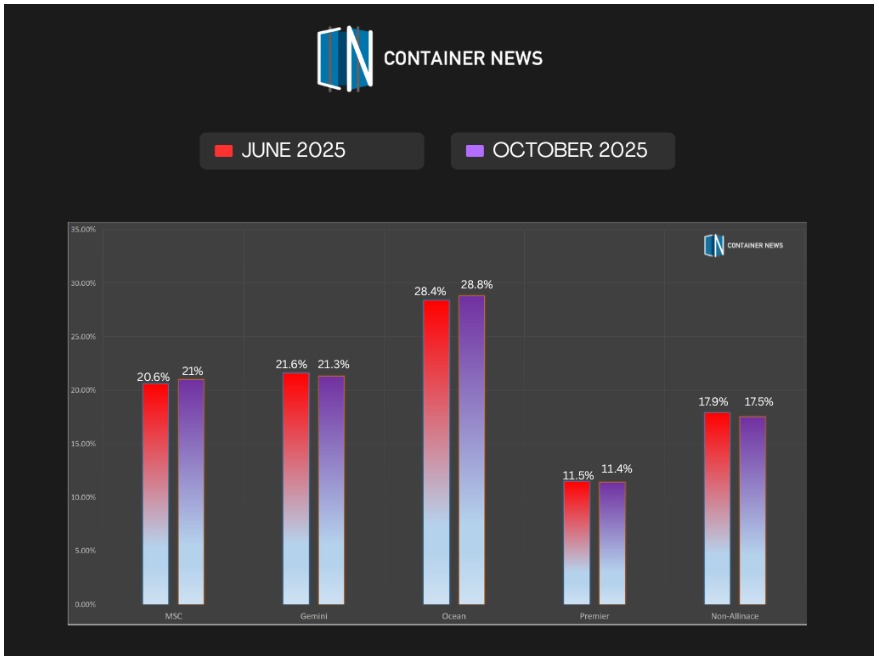
Global market share: 21%, up from 20.6% four months ago
Orderbook: 127 vessels—the largest among all carriers
MSC’s expansion strategy continues to set the pace for industry dynamics worldwide.
Ocean Alliance
(CMA CGM, COSCO, Evergreen, OOCL)
The Ocean Alliance maintains the top spot among alliances, both in fleet size and deployment.
Global market share: 28.8%, up from 28.4%
Combined orderbook: 244 vessels
CMA CGM: 130
COSCO + OOCL: 83
Evergreen: 44
The alliance remains firmly committed to renewal and growth across its member lines.
Gemini Cooperation
(Maersk, Hapag-Lloyd)
The Gemini partners remain a cornerstone of global trade, particularly on the East–West routes.
Global market share: 21.3%, down slightly from 21.6%
Joint orderbook: 103 vessels
Maersk: 71
Hapag-Lloyd: 32
With a restructured network set to launch in the coming year, the pair continues to refine operational efficiency.
The Premier Alliance
(ONE, HMM, Yang Ming)
This alliance remains a formidable presence across high-volume routes, especially in intra-Asia and the trans-Pacific.
Global market share: 11.4%, marginally down from 11.5%
Collective orderbook: 86 vessels
ONE: 51
HMM: 17
Yang Ming: 18
Despite the slight dip, the group retains its competitive standing in major regional and long-haul trades.
Alliance vs. Independent Operators
The combined capacity controlled by the three major alliances plus MSC now stands at 82.5% of global supply, leaving just 17.5% to non-alliance carriers down from 17.9% in June 2025. This incremental but consistent shift reflects a continuing consolidation trend, strengthening the influence of the industry’s largest players over global trade flows.
A Market Defined by Scale and Strategy
The figures confirm a clear reality: the container shipping market is now shaped less by fragmented competition and more by strategic alignment among leading carriers. Alliances offer network efficiencies, cost advantages, and coordinated deployment, while MSC’s independent growth strategy continues to redefine the upper limits of individual carrier influence.
With hundreds of new vessels on order across the leading groups, capacity concentration is expected not only to persist but intensify further entrenching the dominance of these global giants well into the decade ahead.
Source: Container News
As of October 2025, carriers belonging to the major alliances, even without assigning their entire fleets to alliance services, control an extraordinary 82.5% of the world’s container shipping capacity. This represents a subtle rise from 82.1% just four months prior. The steady consolidation highlights the operational efficiency and network reach afforded by alliances, while continuing to limit competitive space for fully independent operators on core East–West trades.
*Market Share Breakdown: October 2025*
MSC (Mediterranean Shipping Company)
Despite remaining outside any formal alliance, MSC continues to dominate as the world’s largest individual carrier.
Global market share: 21%, up from 20.6% four months ago
Orderbook: 127 vessels—the largest among all carriers
MSC’s expansion strategy continues to set the pace for industry dynamics worldwide.
Ocean Alliance
(CMA CGM, COSCO, Evergreen, OOCL)
The Ocean Alliance maintains the top spot among alliances, both in fleet size and deployment.
Global market share: 28.8%, up from 28.4%
Combined orderbook: 244 vessels
CMA CGM: 130
COSCO + OOCL: 83
Evergreen: 44
The alliance remains firmly committed to renewal and growth across its member lines.
Gemini Cooperation
(Maersk, Hapag-Lloyd)
The Gemini partners remain a cornerstone of global trade, particularly on the East–West routes.
Global market share: 21.3%, down slightly from 21.6%
Joint orderbook: 103 vessels
Maersk: 71
Hapag-Lloyd: 32
With a restructured network set to launch in the coming year, the pair continues to refine operational efficiency.
The Premier Alliance
(ONE, HMM, Yang Ming)
This alliance remains a formidable presence across high-volume routes, especially in intra-Asia and the trans-Pacific.
Global market share: 11.4%, marginally down from 11.5%
Collective orderbook: 86 vessels
ONE: 51
HMM: 17
Yang Ming: 18
Despite the slight dip, the group retains its competitive standing in major regional and long-haul trades.
Alliance vs. Independent Operators
The combined capacity controlled by the three major alliances plus MSC now stands at 82.5% of global supply, leaving just 17.5% to non-alliance carriers down from 17.9% in June 2025. This incremental but consistent shift reflects a continuing consolidation trend, strengthening the influence of the industry’s largest players over global trade flows.
A Market Defined by Scale and Strategy
The figures confirm a clear reality: the container shipping market is now shaped less by fragmented competition and more by strategic alignment among leading carriers. Alliances offer network efficiencies, cost advantages, and coordinated deployment, while MSC’s independent growth strategy continues to redefine the upper limits of individual carrier influence.
With hundreds of new vessels on order across the leading groups, capacity concentration is expected not only to persist but intensify further entrenching the dominance of these global giants well into the decade ahead.
Source: Container News